On New Year’s day I had a conversation on Twitter with Sunday Times health correspondent Shaun Lintern. He made the point that the NHS was chronically short £40 billion a year on a European comparison over a 12 year period. [Note the report we will discuss actually looks at the 10 years preceding Covid.] It is an arresting number that he seemed quite wedded to given that it comes from the “respected” Health Foundation think tank. My interest was piqued so I decided to look.


I googled “£40 billion Health Foundation” and found their research and articles from the FT and inews.co.uk that picked it up. The Health Foundation’s research turned out to be simply a presentation of 10 years of comparable data from the OECD, the international body whose job it is to make such comparisons between advanced, industrial economies.
Now we come to the question of what is Europe? The Health foundation wanted to look at the old, established, rich EU-14. Otherwise known as the pre-Accession countries, of which the UK was one when we talked about the EU-15. So the Health Foundation wanted to talk about the richer half of the EU, not Europe.
The next decision the Health foundation made was to set as its benchmark for spending the median of the EU-14 not the mean. I am pretty sure what they have done is chuck out Luxembourg which only has a population of 640K and then choose the middle ranking country in terms of health spending per head which turns out to be France. It has spent 21% more on health (private as well as public) than the UK in the decade 2010-2019. As you can see the Health Foundation calculates the European mean and the French figure to be exactly the same to four significant places, ie 1 in 10,000. Europe is France apparently. It is perfectly respectable to want to copy France but France is not Europe.
It is worth noting that France is quite unusual in European terms. Although its GDP per head matches the UK’s and has done consistently for many years it has very large health spending in terms of percentage of GDP, 1.5% a year of total GDP more than the UK. France was the second highest spender in the world after the US every year 2010-2016. It was pushed down into global 3rd place by Switzerland in 2017, it was 3rd to US and Germany in 2018 and 4th to US, Germany and Switzerland in 2019. France chooses to spend an outsize amount on health and has done for a very long time.
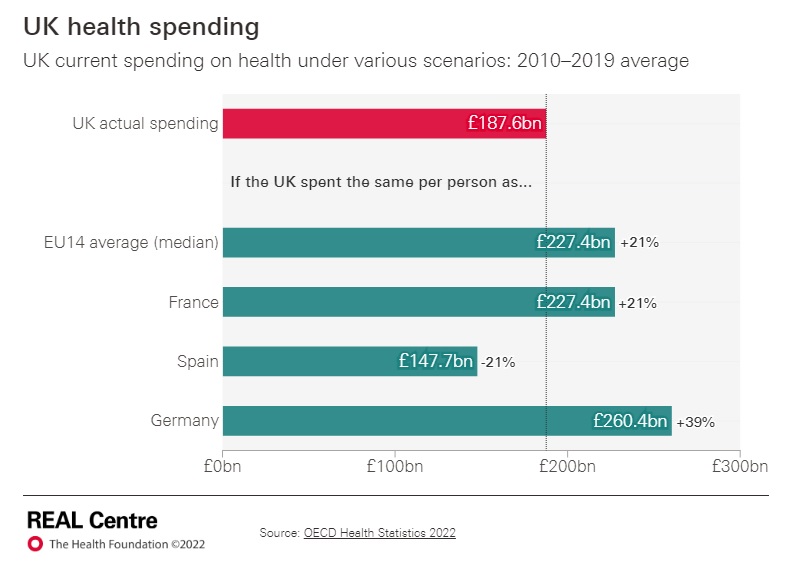
The chart below shows what the Health Foundation has done. By choosing the median rather the mean it has essentially removed the less well performing countries (Italy, Spain, Portugal and Greece) from the average. If you compare the UK with their median (France) the UK is 21% or £40bn a year short of France. If you compare with the mean this goes down to 8% or £15bn a year.
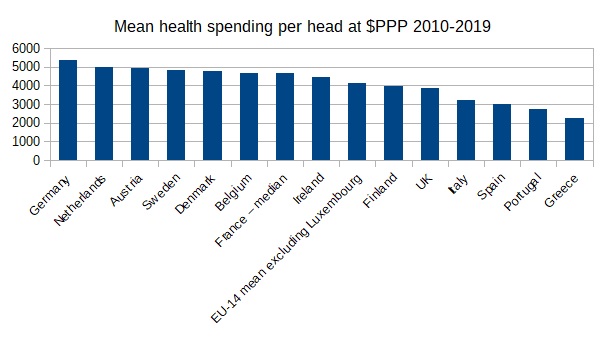
The UK has a large population at 67 million. It might make sense to compare it to other large countries in the EU-14, ie Germany, France, Italy and Spain. In this case the difference goes down to 5.8% or £11bn a year. It you take out the countries under 10 million (ie Denmark, Austria, Finland and Ireland), that might not be able to achieve the economies of scale of larger countries, the deficit drops further to 3.4% or £6.5 billion a year.
If you observe that the three highest spenders in this analysis (Germany, Netherlands and Austria) have very expensive and unrestrained health insurance models, and you take them out, then the difference disappears entirely. Yes, we spend less on average than countries that have a very expensive insurance model that very few people in this country want.
Frankly, I think the Health Foundation has been misleading. In the main body of their original press release they mention the word “average” 5 times in relation to the EU-14 and only mention the word “median” once at the bottom in a note to editors. They should have said up front they were making a comparison with France.
Lintern’s argument that “we had [not] kept pace with Europe”, we could magically have “£40 billion a year extra”, hence “managed decline” and the “NHS has been run down” rests on a statistical sleight of hand. Essentially Lintern and the Health Foundation wants us magically to have found an extra 1.5% of GDP every year for ten years to be like France. When you consider that UK’s payments to the EU were less than 1% GDP, we struggled to get to 0.7% GDP for overseas aid and the defence budget hovers around 2% you can see that 1.5% is not a small amount of money. Yes, we could choose to be like France with a relatively low GDP per head but outsize health spending all the same but some enormous changes to our tax and spending decisions would be required. This is a respectable argument to make but it is an argument that we should be unusual like France.
 Phil Taylor